
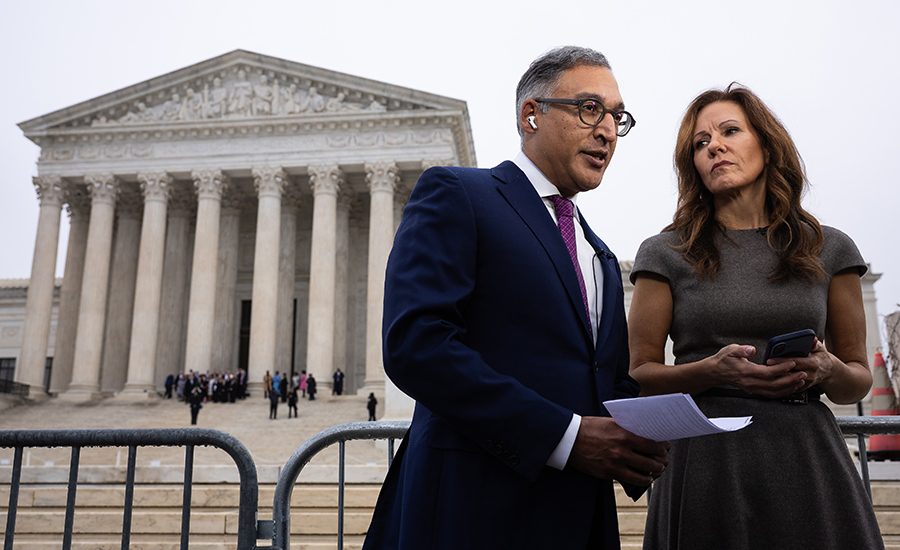

In a 6-3 choice issued Feb. 20, the U.S. Supreme Court docket invalidated President Donald Trump’s use of the Worldwide Emergency Financial Powers Act to impose sweeping reciprocal tariffs in 2025, ruling that the statute doesn’t authorize the chief department to levy duties on imports.
Writing for the Court docket, Chief Justice John Roberts stated IEEPA doesn’t grant the President authority to impose tariffs. “Fulfilling that function, we maintain that IEEPA doesn’t authorize the President to impose tariffs.”
Roberts emphasised that “[t]he energy to impose tariffs is ‘very clear[ly] . . . a department of the taxing energy,’” which the U.S. Structure assigns to Congress.
The Court docket rejected the administration’s studying of IEEPA as allowing tariffs beneath its authority to “regulate” importation, warning that such an interpretation would permit the President to impose tariffs “of limitless quantity and period, on any product from any nation,” as long as a nationwide emergency is asserted.
The ruling dismantles a central pillar of the administration’s 2025 commerce regime. In accordance with the Price range Lab at Yale, roughly $142 billion was collected in 2025 beneath IEEPA authority.
The Court docket affirmed the judgment of the U.S. Court docket of Appeals for the Federal Circuit and vacated the D.C. District Court docket’s ruling, remanding that case with directions to dismiss for lack of jurisdiction.
The Majority: Congress Controls the Tariff Energy
Roberts’ opinion facilities on a constitutional premise: Congress, not the President, controls the facility to levy duties except it clearly delegates that authority.
In search of fast solutions on building and engineering matters?
Attempt Ask ENR, our new sensible AI search device.
Ask ENR →
The Structure offers Congress authority to “lay and gather Taxes, Duties, Imposts and Excises.” The opinion underscores that tariff authority is a part of that taxing energy.
When Congress intends to authorize the President to impose duties or tariffs, the Court docket famous, it does so expressly. IEEPA incorporates no reference to “tariffs” or “duties.”
In a separate opinion for almost all, Justice Elena Kagan wrote that “The President has the flexibility to manage, however to not impose taxes on, imports,” explaining that Congress distinguishes between regulatory authority and revenue-raising authority.
The Court docket grounded its choice in statutory interpretation moderately than the “main questions” doctrine—a judicial precept requiring clear congressional authorization earlier than the chief department workouts powers of huge financial and political significance. Though the tariffs carried sweeping financial penalties, the bulk didn’t depend on that doctrine. As an alternative, it targeted on IEEPA’s textual content and construction.
The opinion declined to create a foreign-affairs exception to odd statutory interpretation ideas, concluding that Congress doesn’t cede core fiscal powers by broad or ambiguous language.
The Dissent: Emergency Authority and Import Regulation
Justice Brett Kavanaugh, writing in dissent, argued that IEEPA’s authorization for the President to “regulate . . . importation” throughout nationwide emergencies consists of the facility to impose tariffs.
In his view, the bulk adopted an unduly slender studying of the statute and didn’t account for the breadth of authority Congress meant to confer in emergency settings.
Kavanaugh additionally addressed the main questions doctrine instantly. Whereas the doctrine requires clear congressional authorization earlier than the chief department workouts powers of huge financial and political significance, Kavanaugh wrote that it mustn’t apply within the foreign-affairs context, noting that six justices wouldn’t apply it in that setting.
He argued that odd statutory interpretation, not a heightened clear-statement rule, ought to govern emergency commerce authority.
RELATED
3Q 2025 Cost Report: Prices Rise as Delayed Impacts of Tariffs Hit Jobsites
Refunds, Reliquidation and the Court docket of Worldwide Commerce
Though the Court docket invalidated the IEEPA tariffs, it didn’t spell out how any refunds of tariffs already paid have to be administered.
Below U.S. commerce legislation, disputes over duties assessed by Customs and Border Safety fall inside the jurisdiction of the U.S. Court docket of Worldwide Commerce. Whether or not importers get better duties paid in 2025 could rely upon procedural posture and the way the commerce court docket constructions reduction.
A key idea is liquidation. When CBP finalizes duties on an entry, that entry is liquidated. As soon as liquidation happens, importers typically have a restricted window to file a protest. If no well timed protest is filed, liquidation turns into remaining.
Worldwide commerce attorneys at Squire Patton Boggs warned that “as soon as liquidation happens, an importer typically can’t get hold of a refund of duties,” underscoring the significance of preserving rights whereas litigation stays pending.
The Price range Lab at Yale said that the court docket didn’t rule out permitting importers to say refunds and it’s seemingly a considerable portion of income raised beneath IEEPA in 2025 might be returned to affected events, although the method stays unsure.
Contractors, nevertheless, mustn’t assume there might be retroactive value reduction. “We now have been cautioning our members for a while now that it’s unlikely they’ll see any refunds for supplies bought throughout the previous yr,” Brian Turmail, AGC vp of promoting, communications, fundraising and market insights, informed ENR in an e mail.
For contractors and suppliers, that uncertainty means tariff prices embedded in 2025 bids could stand even when refunds are in the end issued.
RELATED
Construction Materials Prices Down Slightly in December But Still Up Over a Year Ago
What Authorities Stay
The ruling narrows one statutory pathway, however doesn’t wholly get rid of presidential tariff authority.
In a Feb. 20 shopper alert, legislation agency Thompson Hine wrote that the choice “invalidates the President’s reliance on IEEPA as authority to impose tariffs,” however careworn that it “doesn’t disturb tariffs imposed beneath different statutory authorities, together with Part 232 of the Commerce Growth Act of 1962 and Part 301 of the Commerce Act of 1974.”
The agency added that these statutes “comprise distinct investigative and procedural frameworks that weren’t at problem on this litigation.”
Regulation agency Holland & Knight equally emphasised the separation between IEEPA and other trade tools, writing that “Part 232 tariffs are a separate sort of tariff from the tariffs imposed by way of IEEPA” and that the court docket’s ruling “doesn’t instantly have an effect on these measures.”
The Price range Lab at Yale likewise famous that the administration retains authority to pursue tariffs beneath Sections 201, 232 or 301, or quickly invoke Part 122, which permits tariffs as much as 15% for 150 days with out investigation.
Over time, expanded investigations beneath these statutes may assemble a tariff regime roughly as massive because the one dismantled by the Court docket.
Building Publicity and Trade Response
With out IEEPA tariffs, the general efficient tariff charge is projected to fall however stays traditionally elevated.
The Price range Lab initiatives short-term client costs rise 0.6%, representing roughly $800 per family in 2025 {dollars}, and fashions long-run GDP 0.1% smaller beneath the remaining tariff construction. Building output contracts 2.4% in the long term even absent IEEPA tariffs.
Part 232 tariffs on metal and aluminum stay in place, preserving publicity throughout rebar, structural plate, fabricated metal, curtain wall techniques, heavy gear and constructing techniques elements.
RELATED
Steel, Aluminum Tariffs Will Hit Prices Hard Through Year End
ENR reported in 2018 that Part 232 tariffs triggered double-digit swings in structural metal pricing, complicating procurement schedules and escalation clauses on transportation and vitality megaprojects. Related volatility resurfaced throughout renewed commerce actions in 2025.
Related Builders and Contractors Chief Economist Anirban Basu stated the ruling may ease strain on completed part costs.
“Now that the U.S. Supreme Court docket has overturned IEEPA tariffs, the development business may see a modest however significant discount in supplies value escalation, particularly for manufactured elements like specialty gear, HVAC and electrical techniques, and fixtures,” Basu stated in an e mail to ENR.
However he cautioned that reduction could show momentary.
“After all, the administration has signaled that plans are in place to exchange at the least a few of these tariffs by different means, so the advantages might be short-lived and fully counteracted by heightened uncertainty throughout the transition from one tariff mechanism to a different,” Basu stated.
“That, mixed with the truth that the Part 232 tariffs on uncooked inputs like metal and aluminum will stay in place, implies that this Supreme Court docket ruling may in the end be much less consequential for the development business,” he added.
AGC’s Turmail stated that, except new tariffs are imposed beneath one other authorized rationale, “contractors ought to anticipate to see some reduction in supplies prices within the close to time period,” though longer-term pricing will rely upon how the administration restructures its commerce program.
Trending Merchandise


CRAFTSMAN Pliers, 8 & 10″, 2Piece Groove Joint Set (CMHT82547)


TT TRSMIMA Safety Harness Fall Protection Upgrade 4 Quick Buckles Construction Full Body Harness 6 Adjustment D-ring


BIC Wite-Out Brand EZ Correct Correction Tape, 19.8 Feet, 4-Count Pack of White Correction Tape, Fast, Clean and Easy to Use Tear-Resistant Tape Office or School Supplies

![KwikSafety – Charlotte, NC – TSUNAMI KIT [Premium BRAIDED ROPE] Vertical Lifeline, 1-D Ring Safety Harness, Lightweight Tool Lanyard, Roof Anchor, 20L Dry Bag ANSI OSHA Fall Protection System / 50 FT.](https://m.media-amazon.com/images/I/51inmgg4jlL._SS300_.jpg)