
President Donald Trump’s Dec. 30 veto of laws supposed to ease compensation phrases for a long-delayed federal water undertaking has injected new uncertainty into completion of the Arkansas Valley Conduit, a pipeline already below building solely inside Colorado.
The End the Arkansas Valley Conduit Act was certainly one of two payments Trump vetoed, marking the primary vetoes of his second time period regardless of the invoice’s overwhelming bipartisan passage in each chambers. The opposite measure was unrelated to infrastructure.
The Arkansas Valley Conduit invoice, H.R. 131, didn’t authorize new building funding. As an alternative, it sought to alter how native communities repay the federal authorities by capping native accountability at 35% of building prices and permitting the remaining stability to be repaid over as much as 75 years at a decreased rate of interest, topic to a monetary hardship dedication by the U.S. Bureau of Reclamation.
The invoice was sponsored within the Home by Rep. Lauren Boebert (R-Colo.), with Rep. Jeff Hurd (R-Colo.) as a cosponsor, and launched within the Senate by Sens. Michael Bennet and John Hickenlooper, each Democrats from Colorado.
The measure handed the Home by voice vote and the Senate by unanimous consent on Dec. 14, 2025. Building on the conduit started in 2023, and greater than $200 million has already been invested via a mixture of federal, state and native funding, based on the Southeastern Colorado Water Conservancy District.
RELATED
Drinking Water Leaders Convene to Tackle Funding Challenges, Forever Chemicals
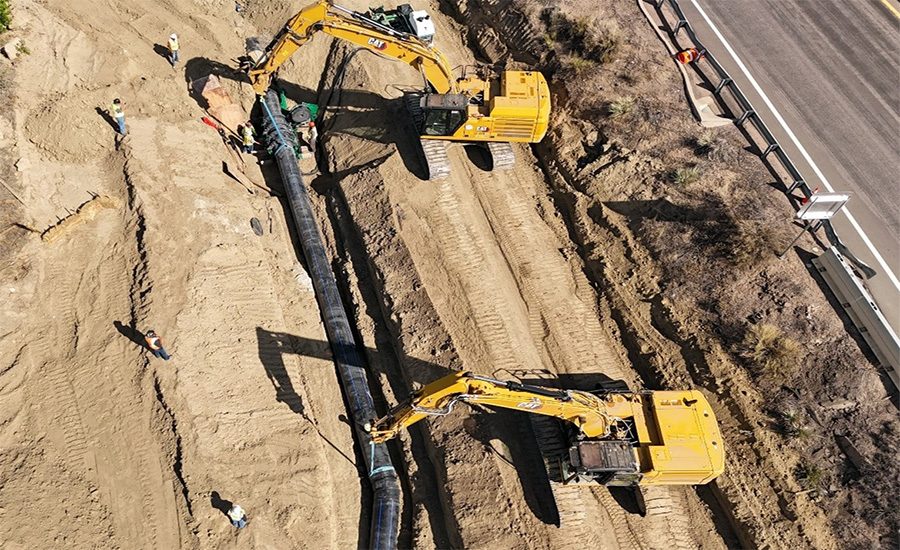
Building is underway on the undertaking’s fundamental trunk line, which incorporates greater than 120 miles of pipeline now being delivered below the Bureau of Reclamation’s rural water program.
As soon as accomplished, the total Arkansas Valley Conduit system is deliberate to incorporate as much as roughly 230 miles of pipeline, together with distribution spurs designed to ship as much as 7,500 acre-ft of handled water per 12 months from Pueblo Reservoir to 39 communities throughout southeastern Colorado.
What It Will Take to End
Whole undertaking prices have climbed to roughly $1.4 billion, based on federal and native estimates, that means effectively over $1 billion in building and supply work stays past the trunk line now below building.
Mission sponsors and federal officials attribute the escalation primarily to building inflation, rising supplies, labor prices and scope growth because the undertaking moved from a long time of planning into phased building. Authentic price assumptions from the undertaking’s Nineteen Sixties authorization didn’t account for contemporary drinking-water remedy requirements, longer distribution laterals wanted to succeed in smaller communities or sharp will increase in metal, concrete and gas costs since 2020. Federal building price indexes present water-infrastructure inputs stay effectively above pre-2020 ranges, compounding price strain on long-duration initiatives just like the conduit.
The undertaking serves communities in Pueblo, Bent, Crowley, Kiowa, Otero and Prowers counties, the place many programs depend on groundwater sources that naturally include radionuclides and don’t meet present federal consuming water requirements. The Bureau of Reclamation has beforehand described the conduit as a vital rural water undertaking wanted to deliver affected programs into regulatory compliance.
RELATED
EPA Parcels Out $6.5B for Drinking Water Infrastructure
With a Veto, What Occurs Subsequent?
In his veto, Trump argued in a message to Congress that it will expose federal taxpayers to further monetary danger.
“My administration is dedicated to stopping American taxpayers from funding costly and unreliable insurance policies,” he wrote. “Ending the large price of taxpayer handouts and restoring fiscal sanity is important to financial development and the fiscal well being of the nation.”
For building, the veto halts a financing adjustment for an lively federal undertaking by altering how present building prices can be repaid, not by blocking new authorization.
“This isn’t a frivolous undertaking,” Chris Woodka, senior coverage and points supervisor for the Southeastern Colorado Water Conservancy District, advised Colorado Public Radio in an interview. “It’s a undertaking that meets federally mandated requirements for water high quality to make sure that 50,000 individuals are consuming clear, not carcinogenic, water.”
Members of Colorado’s congressional delegation stated the veto undercuts a uncommon bipartisan settlement on a rural infrastructure undertaking with substantial sunk prices.
“President Trump determined to veto a very non-controversial, bipartisan invoice that handed each the Home and Senate unanimously,” Boebert stated in a ready assertion.
Hurd stated the laws was designed to guard present investments moderately than increase federal publicity.
“The vetoed laws didn’t authorize new building spending or increase the federal authorities’s authentic dedication,” he stated. “Greater than $200 million has already been invested, alongside important state and native contributions. Additional delay dangers stranding taxpayer {dollars} and leaving communities with no viable path to assembly consuming water requirements.”
Bennet and Hickenlooper additionally criticized the veto and urged Congress to contemplate an override.
Whereas the veto doesn’t instantly halt building, undertaking officers stated present phases are funded and shifting ahead, though future segments would require both a veto override or different financing to proceed on schedule. Unresolved compensation phrases may delay or restrict later phases of the system.
Trending Merchandise


CRAFTSMAN Pliers, 8 & 10″, 2Piece Groove Joint Set (CMHT82547)


TT TRSMIMA Safety Harness Fall Protection Upgrade 4 Quick Buckles Construction Full Body Harness 6 Adjustment D-ring


BIC Wite-Out Brand EZ Correct Correction Tape, 19.8 Feet, 4-Count Pack of White Correction Tape, Fast, Clean and Easy to Use Tear-Resistant Tape Office or School Supplies

![KwikSafety – Charlotte, NC – TSUNAMI KIT [Premium BRAIDED ROPE] Vertical Lifeline, 1-D Ring Safety Harness, Lightweight Tool Lanyard, Roof Anchor, 20L Dry Bag ANSI OSHA Fall Protection System / 50 FT.](https://m.media-amazon.com/images/I/51inmgg4jlL._SS300_.jpg)