
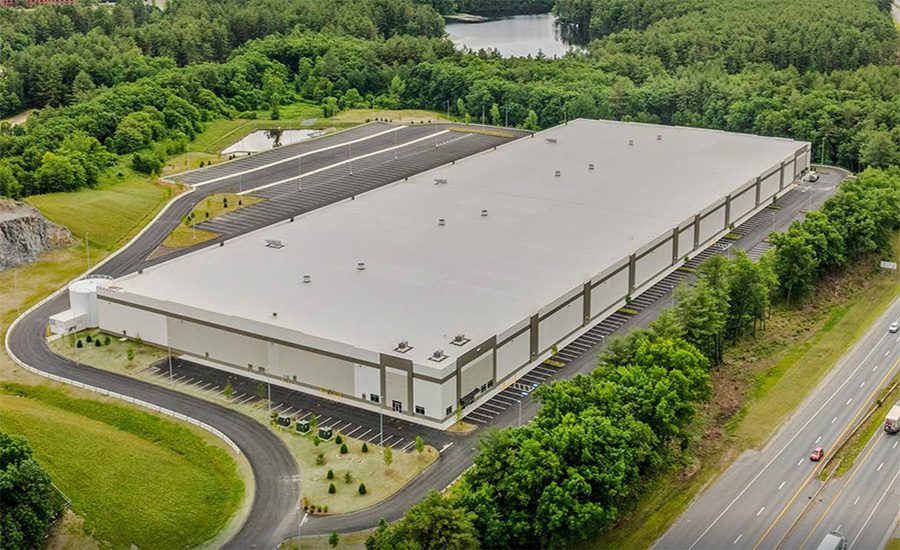
A proposal to transform a big logistics warehouse in Merrimack, N.H., right into a federal immigration processing heart highlights how supply dangers for contractors and designers can emerge nicely earlier than a challenge reaches procurement.
Paperwork launched by way of public-records requests present U.S. Immigration and Customs Enforcement, working underneath the U.S. Dept. of Homeland Safety, notified state historic preservation officers on Jan. 9 that it was contemplating plans to “buy, occupy and rehabilitate” a warehouse property at 50 Robert Milligan Parkway for ICE operations. The correspondence initiated federal assessment underneath Part 106 of the Nationwide Historic Preservation Act however didn’t determine a challenge value, contractor, designer or building schedule.
On the municipal degree, officers say they’ve acquired no formal filings tied to the proposal.
“My workplace has not acquired something in any respect,” mentioned Casey Wolfe-Smith, Merrimack’s planning and zoning administrator, in a telephone interview with ENR. “We don’t have any form of allow functions. There’s nothing on file—no basic contractor or architect hooked up to this. Completely nothing.”
That absence of filings underscores a recurring problem in federally pushed adaptive-reuse tasks: federal businesses can start environmental or historic assessment whereas native land-use processes—and the development groups that depend on them—stay totally unengaged.

A ground plan and inside view illustrate the dimensions of the Merrimack, N.H., logistics warehouse, exhibiting intensive dock frontage and a wide-open inside designed for high-volume distribution fairly than detention or processing use.
Picture courtesy of Cushman & Wakefield
A Class A Logistics Facility
Advertising and marketing supplies for the positioning illustrate the dimensions of the potential conversion. In line with a Cushman & Wakefield brochure, the property totals about 324,000 sq ft, together with roughly 321,000 sq ft of warehouse house and three,400 sq ft of workplace, on a 43-acre website in Merrimack Know-how Park. The Class A facility options 36-ft clear heights, 55 tailboard loading docks, two drive-in doorways, ESFR sprinklers, a 7-in concrete slab and 6,000 amps {of electrical} service.
The constructing was designed for high-volume logistics and superior manufacturing customers, suggesting that any detention or processing use would require intensive inside reconfiguration, a change in occupancy classification, and new safety, life-safety and medical infrastructure.
Searching for fast solutions on building and engineering matters?
Strive Ask ENR, our new good AI search device.
Ask ENR →
Homeland Safety correspondence outlines a potential scope that would embrace “inside modifications” for processing and holding areas, administrative places of work, loos, cafeterias and health-care areas, in addition to exterior work similar to fencing, cameras and access-control options.
The New Hampshire Division of Historic Sources in the end decided that the proposal would end in “no opposed impact” on historic properties, clearing an early federal assessment step. That willpower, nonetheless, doesn’t change native approvals tied to zoning, constructing codes, utilities, site visitors and emergency providers.
RELATED
Dallas Fed Flags Immigration Slowdown Impact on Texas Construction Workforce
Native Opposition and Fiscal Considerations
Merrimack officers have made clear that the city opposes institution of an ICE facility with out native session. In a Jan. 23 letter to the Dept. of Homeland Safety, the city council warned of fiscal and operational impacts if the federal authorities acquires the property.
“If the potential non-verified warehouse is bought by the federal authorities, there could be a $529,000 lower within the tax income,” the letter states. “This might end in a rise within the tax price for our residents.”
The council additionally cited public security issues, writing that “potential difficulties and civil protest would necessitate Police and Fireplace/Rescue Division providers,” creating “potential monetary influence upon these departments and their budgets.”
Gov. Kelly Ayotte (D) has publicly urged federal officers to seek the advice of with Merrimack leaders, emphasizing that whereas immigration enforcement is a federal duty, the impacts of huge amenities are felt regionally.
City officers have mentioned they first realized of the proposal by way of media studies fairly than direct federal outreach, including to uncertainty round timing and scope. For now, Merrimack continues to deal with the positioning as a vacant warehouse. Wolfe-Smith mentioned there have been no pre-application conferences or casual discussions that might point out who may ship the challenge.
“We’ve not had any direct contact with DHS,” she mentioned.
RELATED
Court Halts USDOT Plan to Link State Funding to Immigration, DEI Compliance
That lack of engagement leaves contractors and designers with little visibility into procurement timing or supply construction. Nationally, ICE has been exploring warehouse conversions as a part of a broader detention and processing technique, however formal solicitations tied to particular websites haven’t but been issued.
For the development business, the Merrimack proposal illustrates how adaptive reuse can velocity up federal planning on paper however go away native approvals—and building threat—unresolved.
Trending Merchandise


CRAFTSMAN Pliers, 8 & 10″, 2Piece Groove Joint Set (CMHT82547)


TT TRSMIMA Safety Harness Fall Protection Upgrade 4 Quick Buckles Construction Full Body Harness 6 Adjustment D-ring


BIC Wite-Out Brand EZ Correct Correction Tape, 19.8 Feet, 4-Count Pack of White Correction Tape, Fast, Clean and Easy to Use Tear-Resistant Tape Office or School Supplies

![KwikSafety – Charlotte, NC – TSUNAMI KIT [Premium BRAIDED ROPE] Vertical Lifeline, 1-D Ring Safety Harness, Lightweight Tool Lanyard, Roof Anchor, 20L Dry Bag ANSI OSHA Fall Protection System / 50 FT.](https://m.media-amazon.com/images/I/51inmgg4jlL._SS300_.jpg)