
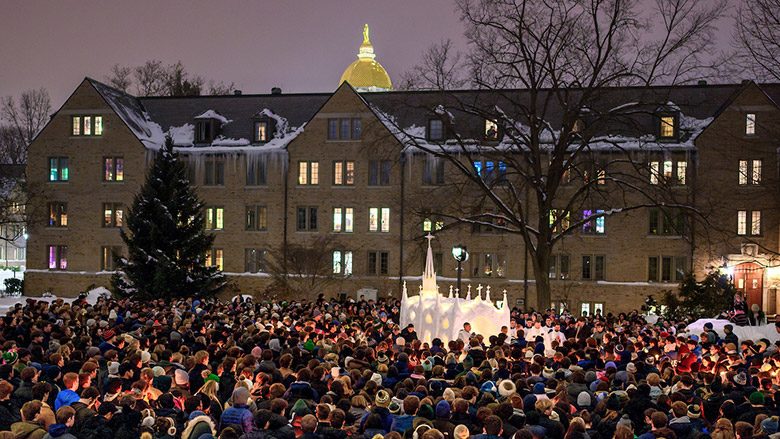

When heavy snow and frigid chilly blanketed the College of Notre Dame campus in South Bend, Ind. in latest weeks, two senior civil engineering and structure majors noticed the inclement situations as a possibility.
They determined to assemble a Gothic-style chapel of snow and ice that examined classes discovered within the classroom, and which after completion drew about 2,500 college students to a candle-lit Mass Feb. 2, withstanding the subfreezing temperature with the construction because the serene backdrop.
From the outset, Wes Buonerba, who’s finding out structure and Martin Soros, a civil engineering main, handled the mission as greater than a snow sculpture. Drawing straight from their tutorial coaching, they designed it as a simplified masonry constructing, modeled after Gothic church buildings that rely virtually completely on compression reasonably than metal or concrete reinforcement.
“It’s primarily a masonry construction,” Buonerba says. “When you’ve got an ideal arch, all of your masonry items are in compression, and that’s very steady. That’s why church buildings had been [historically] constructed like that.”
The chapel is organized round 4 essential rib arches, that are the first structural parts and assist the vaulting between them, transferring the load of the ice downward into the bottom. Between the ribs, Buonerba and Soros added infill partitions, small Roman-style arches for home windows and round openings paying homage to rose home windows—all carved from ice blocks.
Inside, the chapel measured roughly 15 to twenty ft lengthy, about 5 ft vast and 6½ ft tall. Rising above it’s a slender spire weighing about 50 lbs and reaching about 15 to twenty ft into the air.
Studying to Improvise
Making the arches was a problem for the 2, who additionally enlisted as many as ten different pupil volunteers to assist as their time allowed.
Searching for fast solutions on development and engineering subjects?
Strive Ask ENR, our new good AI search software.
Ask ENR →
“We had a noticed in order that we may lower the ice blocks to angle, to chamfer the sides so they’d act extra like a voussoir and an arch,” Buonerba says. “A voussoir is simply an arch or stone block that’s been lower and barely angled so it matches alongside the profile of the arch. The keystone was the central voussoir that locks the arch in place.”
To create the constructing blocks, the scholars used recycling bins as molds, every crammed with alternating layers of snow and water, compacted by hand and boot. The method, Soros says, intently resembled mixing concrete.
“It’s very analogous to the water-to-cement ratio when making concrete,” he says. “Should you put an excessive amount of snow in, the block falls aside. Should you put an excessive amount of water in, it turns into very heavy.”
The coed builders adjusted density of the ice blocks relying on the place they’d be used. Heavier, denser blocks had been positioned decrease within the partitions, whereas lighter blocks had been used at the next degree, significantly for keystones atop arches. The strategy lowered outward forces and eradicated want for in depth buttressing.
To strengthen blocks internally, builders used a long-handled steel ice scraper to punch vertical holes by way of the packed snow earlier than pouring in water. As soon as frozen, ensuing icicles acted like reinforcing bars.
“That was type of like rebar,” Soros says. “You could have a stable ice core down the center.”
Short-term formwork was used to carry arches in place whereas they froze and the 2 needed to improvise to seek out gadgets to adapt for that activity.
“We used something we may get our arms on,” Buonerba says. “I imply, buckets from the basement, trash cans, a automobile hood and ladders from bunk beds. It was something we may use to make this factor.”
The automobile hood supported by two ladders braced aside on the base to counteract gravity was used whereas the keystone was set.
“As quickly as we bought the keystone in, it was just about self-supporting,” Soros says.
Further small transverse arches and skinny ice partitions between the primary ribs helped lock the construction right into a inflexible system, lowering the chance of twisting or collapse if somebody ran into it. At one level throughout development, Buonerba stood on one of many essential arches whereas Soros stood on a smaller window arch, and had been thrilled when each held their weight.
The mission’s water supply was the showers of their dormitory.
In between lessons, Buonerba and Soros had been on website almost continually, investing about 60 hours every.
The chapel shortly grew to become a campus attraction, drawing curious college students, passersby, volunteers and nationwide media consideration. The scholars determined to ask the college to carry a Mass on the location.
Further-curricular Classes
The mission provided classes past structural mechanics. For Buonerba, it strengthened his curiosity in sacred structure and hands-on constructing. For Soros, whose curiosity in civil engineering grew from volunteering on initiatives in South America and seeing the results of insufficient infrastructure, the chapel mirrored the satisfaction he feels in constructing one thing tangible to learn a group.
“It’d appear to be we had been simply youngsters enjoying within the snow,” Soros mentioned, “but it surely actually was making use of what we discovered—primary physics, primary engineering.”
To make an impactful construction, he provides “you do not want one thing spectacular or insanely ornate. We had been simply utilizing what God gave us–the snow that fell and water from showers on the primary flooring.”
The scholars each take pleasure in searching their classroom home windows now to see friends and others on campus visiting the chapel, however neither is sentimental in regards to the construction’s inevitable finish.
“It served its goal,” Buonerba says. “We bought to rejoice Mass with 2,500 college students. It introduced individuals collectively, gave quite a lot of pleasure, and now it is going to soften and return to the earth.”
Trending Merchandise


CRAFTSMAN Pliers, 8 & 10″, 2Piece Groove Joint Set (CMHT82547)


TT TRSMIMA Safety Harness Fall Protection Upgrade 4 Quick Buckles Construction Full Body Harness 6 Adjustment D-ring


BIC Wite-Out Brand EZ Correct Correction Tape, 19.8 Feet, 4-Count Pack of White Correction Tape, Fast, Clean and Easy to Use Tear-Resistant Tape Office or School Supplies

![KwikSafety – Charlotte, NC – TSUNAMI KIT [Premium BRAIDED ROPE] Vertical Lifeline, 1-D Ring Safety Harness, Lightweight Tool Lanyard, Roof Anchor, 20L Dry Bag ANSI OSHA Fall Protection System / 50 FT.](https://m.media-amazon.com/images/I/51inmgg4jlL._SS300_.jpg)