
The U.S. Supreme court docket has dominated navy and development contractors are usually not shielded from state tort claims when misconduct is alleged, even in warfare zones.
The case, Hencely v. Fluor Corp., concerned a declare filed by a U.S. service member who was completely disabled by an assault by a suicide bomber, a Taliban operative working on the time as an worker of Fluor Corp., which was offering navy logistics assist to the U.S. Military in Afghanistan. The bomber, Ahmad Nayeb, had been employed by Fluor as a part of the “Afghan First,” a U.S. navy initiative requiring contractors to rent native staff.
Fluor argued, and the U.S. District Courtroom for the Fourth Circuit in Richmond agreed, that federal legislation pre-empted Winston Hencely’s declare in opposition to the agency and that efforts to carry the agency chargeable for Hencely’s accidents have been unconstitutional. The decrease courts dominated that provisions of the Federal Tort Claims Act shielded navy contractors from state tort claims when the contractors are working beneath navy command in warfare zones.
Nevertheless, Hencely contended that Fluor needs to be held chargeable for the assault as a result of the agency was negligent in supervising the worker in complying with the navy base’s procedures. The Military’s investigation concluded that Fluor didn’t have a transparent sense of whom Nayeb reported to or oversight of the worker.
The Supreme Courtroom sided with Hencely in its ruling launched April 22, written by Affiliate Justice Clarence Thomas, joined by Sonya Sotomayor, Elena Kagan, Neil Gorsuch, Amy Coney Barrett, and Ketanji Brown Jackson. Justice Samuel Alito wrote a dissenting opinion, joined by Chief Justice John Roberts and Brett Kavanaugh.
Within the ruling, the court docket famous that contractors ordinarily have a constitutional protection solely when the contractor is sued for causes associated to what the federal authorities has requested. However the court docket agreed with claims made by Hencely and the U.S. navy that Fluor’s conduct in hiring and retaining the attacker was not licensed by the navy base’s directions as a situation for working on the base.
The court docket concluded that “the preemption rule on with the Fourth Circuit relied lacks any basis within the Structure, federal statues, or our precedents” and vacated the Richmond appeals court docket choice, remanding the case for additional proceedings according to the April 22 ruling.
On the lookout for fast solutions on development and engineering subjects?
Attempt Ask ENR, our new sensible AI search software.
Ask ENR →
Within the dissent, the justices famous that language to rent native Afghans as a part of the federal “Afghan First” program was written into Fluor’s contract. “As a result of the Structure offers the federal authorities unique authority over overseas affairs and the conduct of wars, federal legislation preempts all state legislation that considerably interferes with the federal government’s train of these powers.”
In an e mail, Fluor mentioned: “Fluor is conscious of the USA Supreme Courtroom’s ruling and, though upset, we respect the court docket’s choice. Since litigation remains to be ongoing, we won’t remark additional.”
Enbridge Line 5 Pipeline Challenged
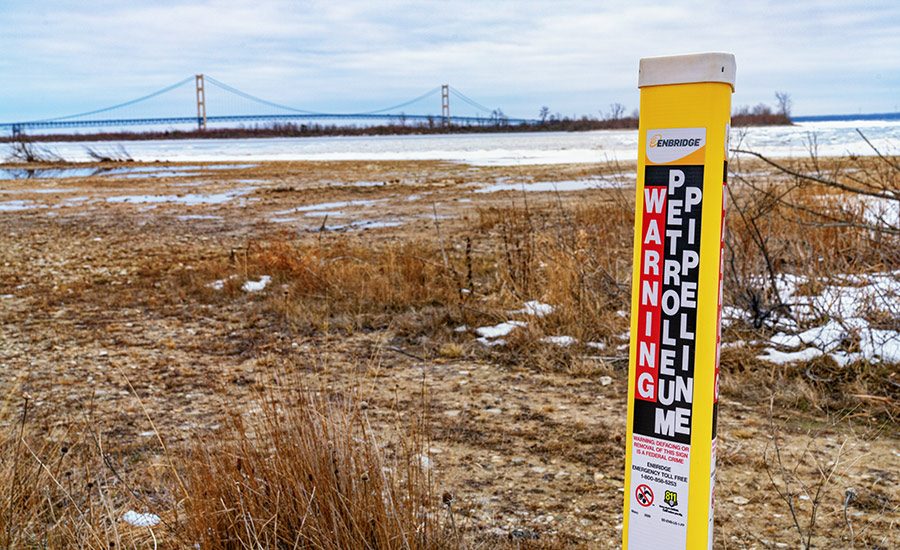
In a separate case, additionally launched April 22, court docket justices unanimously dominated that Enbridge had failed to satisfy deadlines required beneath federal legislation to maneuver a long-running case difficult the corporate’s operations of a 645-mile petroleum pipeline in Michigan and remanded the case to the state court docket. Michigan Lawyer Common Dana Nessel in 2019 challenged the continued operations of the Line 5 pipeline, saying that potential oil spills would violate state environmental legal guidelines.
Enbridge contended that the case needs to be heard in federal, not state court docket, however didn’t file a petition in federal court docket inside the 30-day time restrict required by federal legislation. In consequence, Mich. Gov. Gretchen Whitmer (D) known as for the pipeline to be shut down.
The excessive court docket concluded that “Enbridge discover of elimination [to federal jurisdiction] was premature and that this motion should be remanded to the Michigan state court docket.”
In an emailed assertion, an Enbridge spokesperson mentioned, “Setting apart the procedural choice, the actual fact stays that the protection of Line 5 is regulated completely by the Pipeline and Hazardous Supplies Security Administration (PHMSA), an company inside the U.S. Division of Transportation. PHMSA conducts annual inspections and critiques of Line 5’s operations throughout the Straits of Mackinac and has persistently discovered the pipeline to be in compliance, figuring out no questions of safety that might warrant its shutdown.”
In an amicus temporary filed on behalf of Enbridge, the North American Constructing Trades Unions and the United Steelworkers union wrote, “NABTU and USW have a powerful curiosity on this case, which might decide the longer term employment and well-being of hundreds of [the unions’] members.
Trending Merchandise


CRAFTSMAN Pliers, 8 & 10″, 2Piece Groove Joint Set (CMHT82547)


TT TRSMIMA Safety Harness Fall Protection Upgrade 4 Quick Buckles Construction Full Body Harness 6 Adjustment D-ring


BIC Wite-Out Brand EZ Correct Correction Tape, 19.8 Feet, 4-Count Pack of White Correction Tape, Fast, Clean and Easy to Use Tear-Resistant Tape Office or School Supplies

![KwikSafety – Charlotte, NC – TSUNAMI KIT [Premium BRAIDED ROPE] Vertical Lifeline, 1-D Ring Safety Harness, Lightweight Tool Lanyard, Roof Anchor, 20L Dry Bag ANSI OSHA Fall Protection System / 50 FT.](https://m.media-amazon.com/images/I/51inmgg4jlL._SS300_.jpg)