
Amid rising considerations over crude oil motion via the Strait of Hormuz and long-term dangers within the escalating U.S-Israel-Iran warfare, China is fast-tracking funding and work on a number of new non-fossil gasoline energy tasks, amongst others that had been deliberate earlier.
Imports nonetheless account for 80% of China’s oil wants, half of which passes via the Hormuz waterway, now blocked by Iran. Whereas the Chinese language international ministry. mentioned in an announcement the nation “will do what is important to guard its vitality safety,” observers equivalent to Columbia College’s Center on Global Energy Policy are skeptical on whether or not could take an energetic function within the battle, with as much as 1.4 million barrels of oil now in reserve within the nation and crude oil making up simply 20% of whole nationwide vitality consumption in 2024.
Wind, nuclear, photo voltaic and hydropower generated greater than one-third of China’s electrical energy in 2025, in response to authorities company statistics, with greater than half of expanded put in transmission capability now from clear sources.
“The present Iran disaster primarily provides robust narrative for presidency to justify these investments and presumably shift extra fiscal assist for the vitality tasks,” Dan Wang, Singapore-based China director at assume tank Eurasia Group, instructed ENR.
Current authorities bulletins be aware new developments on two giant nuclear vitality tasks, a pumped hydroelectricity storage growth, EV charging clusters, a brand new transmission line and new tools enabling use of hydrogen vitality.
“The looming vitality disaster on account of this warfare will undoubtedly inspire China to fast-track such non-fossil vitality tasks with a purpose to cut back its dependence on imported crude and gasoline,” Zhiqun Zhu, a Bucknell College worldwide relations professor and director of its China Institute instructed ENR.
Nuclear Vegetation Transfer Ahead
Searching for fast solutions on development and engineering subjects?
Strive Ask ENR, our new sensible AI search software.
Ask ENR →
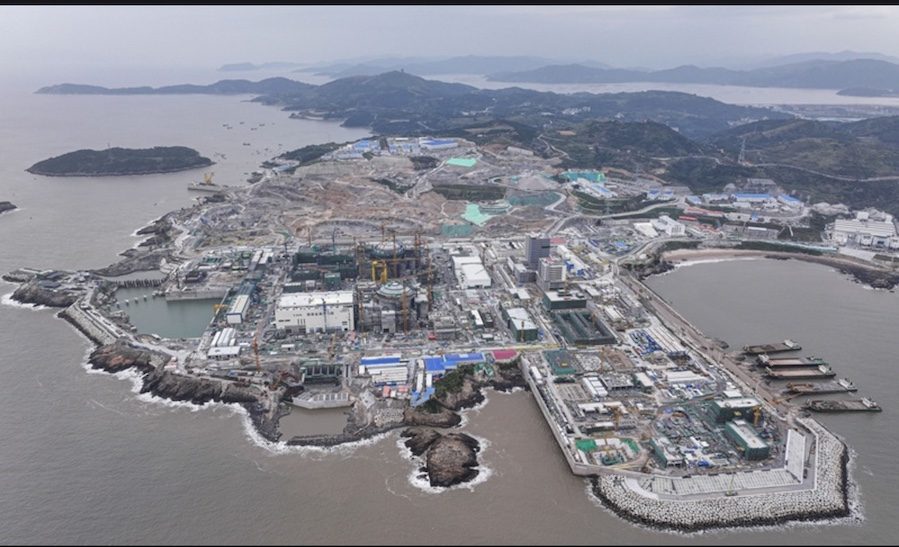
Steps taken this month embody connecting the primary two items of China’s San’ao-1 nuclear energy plant, about 2.2 MW of capability to the nationwide grid in Zhejiang Province and the Yangtze River Delta area, state owned China Normal Nuclear Corp. introduced March 12. It and different state owned entities maintain 46% of shares of the mission firm Cangnan Nuclear Energy, with a Chinese language non-public fairness agency having a 2% stake, the primary such mission with non-public sector involvement. Reviews cite the mission development price at $10.2 billion for its first section.
When accomplished, the mission is ready to characteristic six Chinese language-made pressurized water reactors utilizing the Hualong One design, which is able to generate 54 billion kWh of energy yearly. It should save greater than 16 million tonnes of coal and greater than 50 million tonnes of CO₂ emissions every year, China Normal Nuclear mentioned.
China additionally introduced in early March an acceleration of the estimated $5.6-billion first-phase of the $16.7-billion Bailong nuclear energy plant in Guangxi province. It should characteristic two CAP1000 reactors, described as an uprated model of the AP1000 design developed by U.S.-based Westinghouse. Development on the primary unit started in December 2025. As soon as absolutely operational, the primary two items would offer 20 billion kilowatt-hours of energy yearly.
On the assembly earlier this month of the Nationwide Folks’s Congress, China’s parliament, the federal government additionally revealed plans to create a brand new goal of 100 GW of pumped hydro storage to stabilize the grid because it integrates extra wind and solar energy.
The China Academy of Aerospace Propulsion Know-how additionally introduced on March 9 4 new hydrogen vitality merchandise specializing in manufacturing, storage, and refueling to advance the sector’s large-scale industrial utility. The federal government additionally revealed plans to create zero-carbon transport corridors that contain constructing hydrogen refueling and high-power EV charging “clusters” alongside main highways to exchange diesel-reliant freight.
China’s Nationwide Reforms Improvement Fee additionally introduced a plan to assemble a 3rd line on the Hami–Dunhuang 750-kV transmission system connecting Xinjiang and Gansu provinces to additionally allow extra clear energy export to different elements of the nation. It’s set to complete by March 2027.
Trending Merchandise


CRAFTSMAN Pliers, 8 & 10″, 2Piece Groove Joint Set (CMHT82547)


TT TRSMIMA Safety Harness Fall Protection Upgrade 4 Quick Buckles Construction Full Body Harness 6 Adjustment D-ring


BIC Wite-Out Brand EZ Correct Correction Tape, 19.8 Feet, 4-Count Pack of White Correction Tape, Fast, Clean and Easy to Use Tear-Resistant Tape Office or School Supplies

![KwikSafety – Charlotte, NC – TSUNAMI KIT [Premium BRAIDED ROPE] Vertical Lifeline, 1-D Ring Safety Harness, Lightweight Tool Lanyard, Roof Anchor, 20L Dry Bag ANSI OSHA Fall Protection System / 50 FT.](https://m.media-amazon.com/images/I/51inmgg4jlL._SS300_.jpg)