
It’s not but Halloween, however issues within the HR world may very well be summed up as “spooky,” Zach Nunn, CEO of expertise administration agency Residing Company, informed HR Dive.
U.S. organizations have requested their HR groups to conduct a record number of layoffs this yr — typically doing so a number of instances all through the course of 2025 in a “serial” fashion, in accordance with a current Careerminds survey. However whereas organizations concentrate on slicing prices by means of attrition, additionally they are deprioritizing investments in present employees, in accordance with Nunn.
“The fact is that individuals initiatives are simply not being invested in,” he mentioned. “What we’re seeing is a large-scale divestment from the worker expertise within the day-to-day work, and that’s a scary place to be in, as a result of if we’re not going to be investing in folks, how will we create wholesome experiences for purchasers?”
HR professionals are feeling squeezed, too, in accordance with a SHRM’s 2025 State of the Office report revealed in March. The affiliation discovered that 62% of pros have been working past their capability, and 57% mentioned their departments were understaffed.
Business analysts expected that 2025 would bring its share of challenges, from the push to undertake synthetic intelligence, reframe DEI playbooks and adapt expertise operations to market fluctuations. Greater than midway by means of the yr, these predictions are largely holding true, sources who spoke to HR Dive mentioned, although some traits have taken just a few surprising turns.
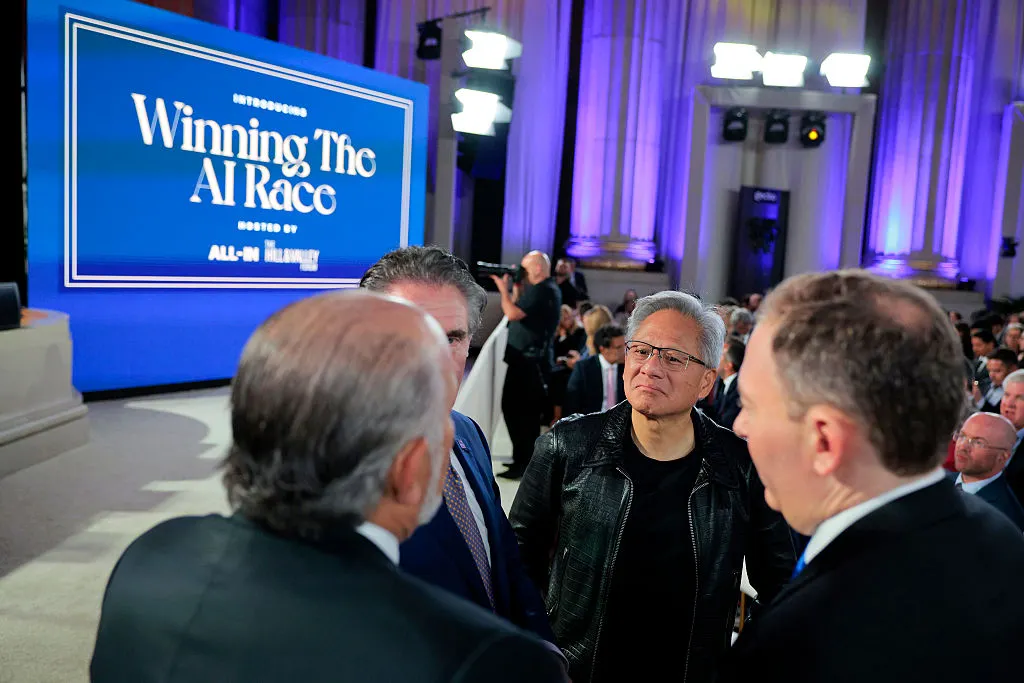
CEO of NVIDIA Jensen Huang speaks with Trump administration officers through the “Profitable the AI Race” summit on the Andrew W. Mellon Auditorium on July 23, 2025, in Washington, D.C. Cracks have begun to point out in office synthetic intelligence adoption, sources informed HR Dive.
Chip Somodevilla by way of Getty Pictures
The AI hype cycle hits some roadblocks
After years of hype, AI has grow to be more and more mainstream at work, with a Might Owl Labs report discovering that 67% of firms integrated AI tools into their organizations for work-related functions. However there are cracks starting to point out on the adoption entrance as employers wrestle to search out good use circumstances for the know-how, mentioned Emily Rose McRae, senior director analyst at Gartner.
A typical sticking level is that employees merely don’t have the information to correctly use AI, which necessitates further coaching. However when management groups go to HR with a request to enhance coaching or construct worker ability units to higher reap the benefits of AI, “that’s sadly not terribly reasonable,” McRae mentioned, as a result of the training curve concerned is commonly too steep.
Generative AI adoption faces different limitations from unclear use circumstances to meager productiveness positive aspects — some vendor estimates present that whereas the tech can save users minutes of work in a typical day, the instruments “don’t have a drastic influence on productiveness,” McRae mentioned. Because of this, executives need to HR to not solely establish good use circumstances for AI but in addition to upskill employees to make sure uptake is feasible within the first place.
“That can be a tough spot to be in,” McRae mentioned. “HR has a accountability round coaching, nevertheless it additionally has a task in reshaping executives’ expectations and getting folks to reimagine the outcomes which might be attainable.”
By the numbers
95%
Proportion of enterprise generative AI pilot packages with no measurable profit-or-loss influence, in accordance with an MIT report
40%
Proportion of agentic AI tasks that may very well be cancelled by the top of 2027 on account of prices, unclear enterprise worth or insufficient danger controls, per Gartner
As if to underscore these difficulties, a current MIT report discovered that the overwhelming majority of enterprise generative AI pilot packages, 95%, had no measurable profit-or-loss impact on their organizations. The report’s findings don’t imply that AI has no impactful use circumstances, McRae mentioned, however they do present that figuring out the proper use circumstances is probably not as straightforward as distributors would have HR consider.
Within the near-term future, she added, HR might want to specify what targets AI is getting used to attain inside the group, whether or not that is worker adoption, participation coaching or another metric. “In the end, it’s a must to determine what stakeholders need within the brief time period [and] set it in opposition to your longer-term targets, which could imply resetting expectations.”
That is additionally more likely to imply that HR might want to work throughout departments, together with with info know-how and particular person workforce leads, to find out how AI can greatest be of use to staff or select present sources that might higher fulfill sure targets than AI.
Nunn mentioned firm expectations round AI current their very own hurdles. AI can contribute to enterprise technique and processes in a lot the identical method as a school intern may, he added, however the push by organizations to outsource departments wholesale to the tech is probably going unrealistic given AI’s limitations.
“Sadly, we’re seeing large-scale functions of AI when it comes sourcing, recruiting and background checks — primarily seeing entire HR departments being changed by one bot,” Nunn mentioned. “It’s to not say that AI doesn’t have a task in HR processes — numerous what we see as HR may be very transactional, repetitive and monotonous — however it’s to say that there’s a possibility for organizations to, as a substitute of wholly changing folks, to improve the position, not essentially substitute the position.”
There are some indicators that organizations have begun to acknowledge that actuality. Nunn pointed to 2024’s information that McDonald’s rolled back its plan to implement AI cashiers in its drive-thrus for example, whereas Gartner revealed analysis earlier this yr exhibiting that some 40% of agentic AI projects could be cancelled by the top of 2027 on account of prices, unclear enterprise worth or insufficient danger controls.
Nunn mentioned it’s pure for firms to overindex on know-how traits, however there may be nonetheless a necessity to determine what AI’s actual worth proposition is. “The scary half is that, whereas we’re preventing that out in actual time, we’re seeing human beings be negatively impacted,” he added, referencing current layoffs in addition to the continuing discrimination lawsuit against HR vendor Workday over its automated hiring programs.
It is going to be essential for HR departments to make sure their distributors usually are not committing the identical errors that individuals sometimes commit when reviewing candidates’ resumes, conducting background checks and comparable practices, Nunn mentioned.
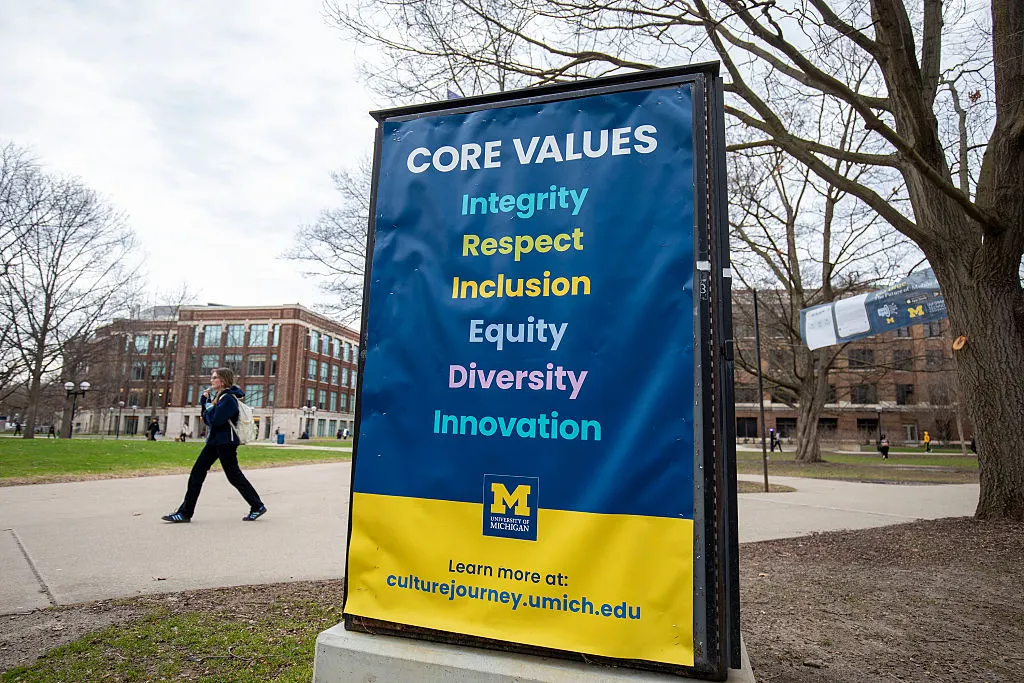
College of Michigan college students stroll subsequent to signage displaying core values, together with range, fairness and inclusion, on April 3, 2025, in Ann Arbor, Mich. Some employers are shifting DEI initiatives to instantly tackle enterprise targets and incorporate a broader array of staff’ lived experiences.
Invoice Pugliano by way of Getty Pictures
Practitioners hold DEI alive with concentrate on enterprise targets
The gloomy outlook range, fairness and inclusion packages confronted at first of 2025 has largely held. As many as 1 in 5 employers have jettisoned their programs for the reason that reelection of President Donald Trump — an outspoken DEI opponent — in accordance with a Resume.org survey, with extra anticipated to take action over the subsequent yr.
Trump, in his first yr again in workplace, initiated a broad federal crackdown on DEI, focusing on each public- and private-sector workplaces that maintained DEI packages. The U.S. Equal Employment Alternative Fee has additionally sent letters threatening to investigate employers for various hiring practices, sure worker useful resource group customs and comparable actions.
DEI practitioners nonetheless proceed their work and, in doing so, have in some circumstances refined their packages to reply to the backlash. That’s the strategy taken by meal supply firm Feast & Fettle, in accordance with Kyla Hanaway-Quinlan, the corporate’s chief working officer and head of individuals.
Particularly, Feast & Fettle’s DEI programming is targeted on constructing and investing within the group’s expertise with an emphasis on upward mobility and equal alternative, she added, unbiased of the broader cultural and political temperature on the topic. Hanaway-Quinlan mentioned she believes this technique avoids backlash that, in her view, has are available in response to packages that have been unexpectedly designed or extra centered on advantage signaling than enterprise targets.
“My lens on that is that there was a lack of know-how or intentional design round what worth having fairness in your workforce offers to your group,” Hanaway-Quinlan mentioned. “And so it’s in some methods unsurprising that the wheels are beginning to come off, as a result of [DEI programs] weren’t all the time substantial or grounded within the enterprise wants to start with.”
Hanaway-Quinlan mentioned her group’s packages tie again to Feast & Fettle’s want for the upward financial mobility of its staff in addition to the exterior limitations that inhibit this mobility. That perspective comes from Feast & Fettle’s expertise hiring employees from various backgrounds, together with work with group teams that help people who find themselves previously incarcerated, have developmental disabilities or who’re experiencing homelessness.
“Your programs must work in the direction of the objective you’re attempting to perform.”

Kyla Hanaway-Quinlan
Chief working officer and head of individuals, Feast & Fettle
In that sense, DEI is much less about particular demographics like race or gender, and extra so concerning the broad array of lived experiences staff carry to the workforce. “Lived experiences usually are not simply an expertise of while you’re filling out your EEOC kind and what bins you’re checking,” Hanaway-Quinlan mentioned. “It’s broader than that.”
Feast & Fettle hasn’t modified the way in which it talks about DEI largely as a result of “the language was all the time geared towards upward mobility and financial pathways for individuals who’ve labored in hospitality and skilled limitations to employment,” Hanaway-Quinlan continued.
On the recruiting entrance, Hanaway-Quinlan mentioned the corporate sticks with a equally intentional strategy that focuses on group, which suggests exhibiting as much as networking occasions the place the expertise pool it needs to domesticate exhibits up. It additionally works in partnership with native organizations and faucets present staff’ networks for referrals.
“It actually begins with an preliminary program design that’s constructed round enterprise aims,” Hanaway-Quinlan mentioned, with a very powerful of those being delivering worth to prospects. “Your programs must work in the direction of the objective you’re attempting to perform.”
Opposition to DEI is an impediment, however employers can take the chance to grasp why folks really feel that DEI has made them unable to entry one thing, or why working towards values like fairness make them really feel omitted, Hanaway-Quinlan added.
“Participating with extra curiosity typically helps battle decision,” she mentioned, noting that, if staff oppose DEI or a component of DEI, “I actually wish to perceive what which means to them and why it’s that they don’t really feel a part of that dialog.”
Total, Gartner’s McRae mentioned she is seeing a “robust shift” towards inclusion in DEI work, as firms search to retain various workforces whereas recognizing the pressures created by the broader surroundings to dial again. One barrier to deal with is the problem of measuring inclusion, which isn’t as simply quantified as different parts of DEI; “that doesn’t imply you possibly can’t do it, it simply means it takes extra work,” McRae mentioned.
Employers can reshape their packages in different methods, transitioning away from utilizing potentially illegal metrics like quotas or creating development packages just for staff of a selected race or gender. In deciding how to decide on contributors in a mentorship initiative, for instance, McRae mentioned employers might ask staff to write down an essay on why an absence of mentorship has damage their careers.
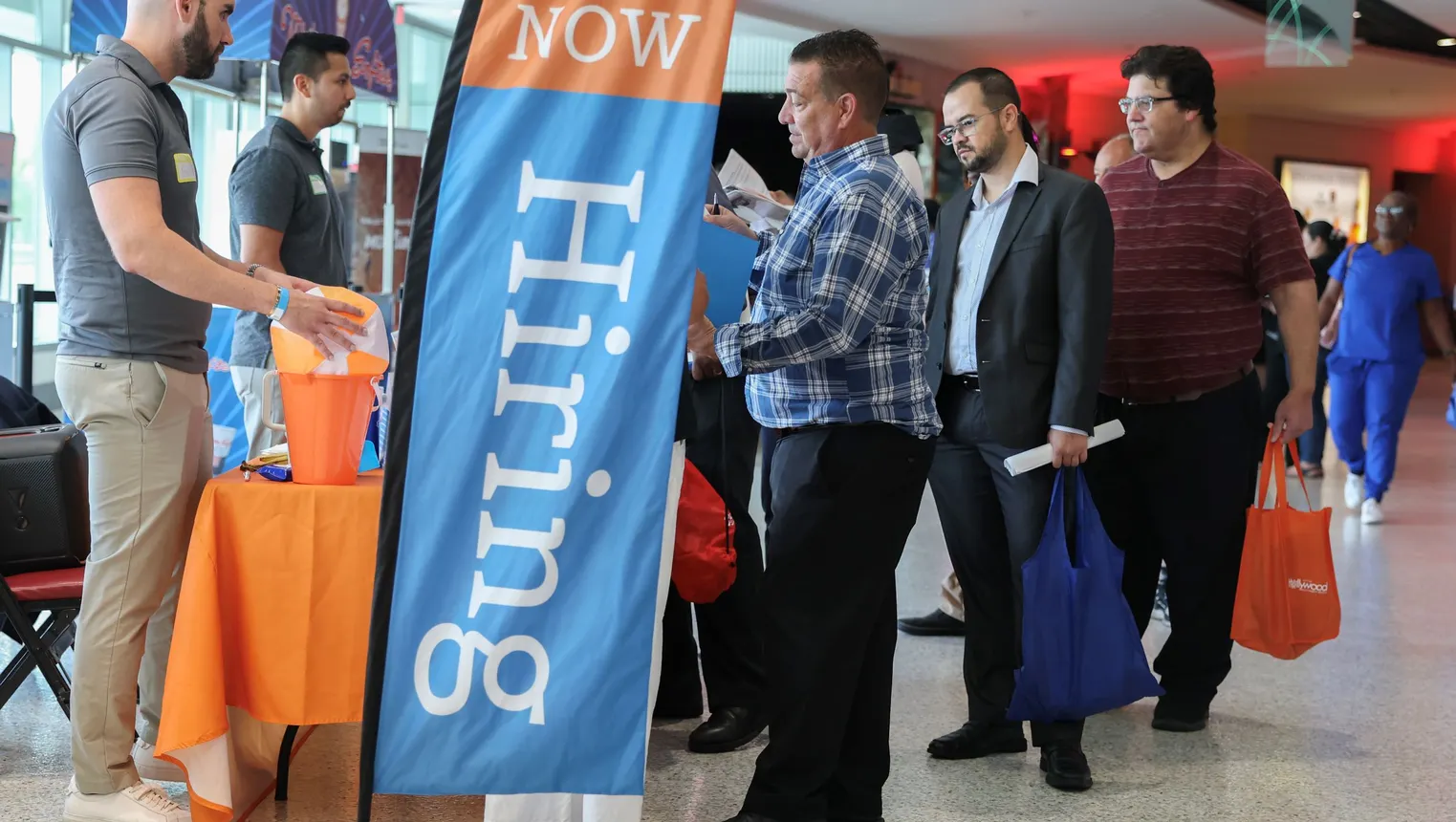
A job seeker speaks with a recruiter at a job truthful on April 30, 2025, in Dawn, Fla. Regardless of a slew of layoffs and different indicators, some sources disagree that the present labor market is a positive one for employers.
Joe Raedle / Workers by way of Getty Pictures
The employer-friendly job market is probably not what it appears
With layoffs surging and workers sometimes clinging to their jobs for concern of an absence of alternatives elsewhere, it could be straightforward to imagine that the market is leaning in employers’ favor. AI is playing a role here, too, with respondents to a Shopify survey launched in April admitting that the tech factored into their layoff choices.
The push to automate extra work and shed payroll factors to a broader query concerning the state of the employee-employer relationship, Nunn mentioned, and HR wants to concentrate to these dynamics shifting ahead.
“HR is in a tricky place,” Nunn mentioned, and that’s particularly the case with AI, the place departments could really feel pressured to deploy the tech with out first analyzing what the implications of a botched or ineffective rollout may be. Professionals must ask the best questions on AI so as to be true enterprise companions, he added.
Pushing again on AI and different top-down initiatives may not really feel pure to HR, however “the very last thing you wish to do is go together with [them] after which understand you additionally don’t have a job,” Nunn mentioned.
Not all observers agree that the slew of layoffs and comparable dynamics essentially replicate an employer-friendly expertise market, nonetheless. McRae mentioned employers proceed to wrestle with altering worker wants and what job candidates consider they’re keen to tolerate from employers.
“I don’t get the impression that employers are completely snug with that shift,” McRae mentioned. This may be seen in areas equivalent to worker advantages, the place niche offerings are increasingly in-demand amongst prime expertise. Flexibility stays a wish-list merchandise for candidates, too, even as the RTO debate settles.
Employers, McRae mentioned, could also be “dreaming of the times when staff would settle for what they got,” in comparison with the post-pandemic period by which “folks have been seeing that they may get by with much less and have been keen to not get a job.”
A downturn might create additional adjustments, however McRae mentioned she isn’t satisfied that this may essentially lead staff to tolerate extra restrictive work preparations.

Staff are welcomed again to work with breakfast within the cafeteria on the Chicago Google places of work on April 5, 2022, in Chicago, In poor health. Employers that place limits on flexibility want to make sure the in-office expertise delivers on their said causes for RTO, sources informed HR Dive.
Scott Olson / Workers by way of Getty Pictures
Staff see by means of poorly executed RTO
Organizations have referred to as staff again to the workplace for quite a few causes, amongst them shedding employees. A Might report by Resume Templates discovered that greater than half of surveyed firms have been utilizing methods, together with mandating additional time within the workplace, as a means of “quiet firing” workers reasonably than conducting formal layoffs.
Even so, employers’ strategy on flexibility has largely remained the identical as in recent times, mentioned McRae. That’s due to the position that versatile work choices can play in attracting expertise, even when a hybrid mannequin is obtainable as a substitute of absolutely distant work. It’s additionally straightforward for employees to identify RTO choices which have weak rationales.
“Staff are nicely conscious when employers have RTO methods which might be based mostly on employer comfort or coverage agreements or that kind of factor,” McRae mentioned. “Not many employers are invested in making the time an worker spends within the workplace a differentiated expertise the place there’s a motive we’re asking you to do that versus staying residence.”
The trope of calling workers to the office to collaborate is an oft-cited one in executives’ RTO directives, but when employers are earnestly doing so, they should know the way they plan to facilitate this, McRae continued; “should you say it’s due to collaboration or team-building, you higher be delivering that.”
Staff must advocate for the flexibleness that they want, Nunn mentioned, however employers additionally should acknowledge the potential limits that they’re putting on recruitment after they take away flexibility as an choice.
“I’ve 4 kids, and there’s sure jobs I simply can’t work,” Nunn mentioned. “If in case you have staff who want varied issues, and also you’re rigid on find out how to present these issues, you’re not going to have an efficient workforce or buyer expertise. You’re not going to win within the market such as you need.”
Nunn added that organizations that hearken to expertise and are conscious about how they help employees can anticipate to compete nicely for expertise, notably within the occasion that the job market takes a extra worker-friendly flip.
“Issues shift on a regular basis,” he mentioned. “What you don’t need is to have people who find themselves resentful to be right here. It’s greatest to steer with kindness even if in case you have the capability to be merciless.”
Trending Merchandise


CRAFTSMAN Pliers, 8 & 10″, 2Piece Groove Joint Set (CMHT82547)


TT TRSMIMA Safety Harness Fall Protection Upgrade 4 Quick Buckles Construction Full Body Harness 6 Adjustment D-ring


BIC Wite-Out Brand EZ Correct Correction Tape, 19.8 Feet, 4-Count Pack of White Correction Tape, Fast, Clean and Easy to Use Tear-Resistant Tape Office or School Supplies

![KwikSafety – Charlotte, NC – TSUNAMI KIT [Premium BRAIDED ROPE] Vertical Lifeline, 1-D Ring Safety Harness, Lightweight Tool Lanyard, Roof Anchor, 20L Dry Bag ANSI OSHA Fall Protection System / 50 FT.](https://m.media-amazon.com/images/I/51inmgg4jlL._SS300_.jpg)